This is the finished layout pictured from above.
The distinguishing technical features of the layout are that it has
a 6-inch turn radius in N-scale track allowing a substantial trip
length on three levels in a small space,
and it is an end-to-end design that uses a
P684SV train controller
to automate train operation between stations.
It is an almost-bookshelf design, 13" deep and just over 20" long.
This means that it will sit and operate on a bookshelf provided
it is a deep shelf.
The turn radius means that pretty much only 4-wheel rolling stock
has a chance of negotiating the track, though I have a Fleischmann
20-ton shunter with twin 4-wheel bogies that will do the run.
Here is a video of the layout working:
Construction Details
Like the "Journey" layout, this one saw work on two continents and took
some time from start to finish... but only about a year, compared to a
decade for the Journey. Here you see the chassis, constructed in
February 2006, while we were still in California.
The diameter of turn (2x the radius of curvature)
is between 12 and 13 inches.
N-scale normally does not allow a radius of curvature
less than about 9 inches, giving a diameter of turn
of 18 inches. (The usual US minimum radius is 9.25 inches,
the German one about 8.7 inches.)
This means that only short cars will be able to negotiate
the track, but the layout is sized like a Z-scale layout.
It is about 13 by 20 by 9 inches.
This is the chassis from below, with the bottom
cover board removed, to show some of the
block detectors
that will allow the layout operation to be automated.
The terrain was fashioned by using foam packing "nuts"
the shape of knuckle-bones as bricks, with hot glue
as mortar. This was subsequently covered with plaster
cloth.
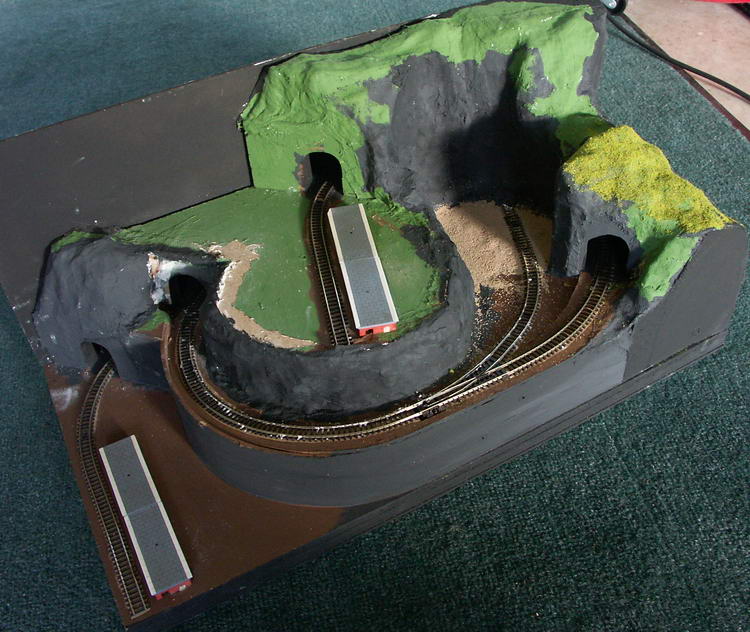
Here is the layout after the terrain was covered and
crudely painted, platforms added and some grass and
gravel added.
The plan is for a small train to run between the bottom
station and either the quarry or the top station.
The track is an end-to-end design, so the train must reverse
at each station. This is facilitated by the block detectors
and a P684SV train controller.
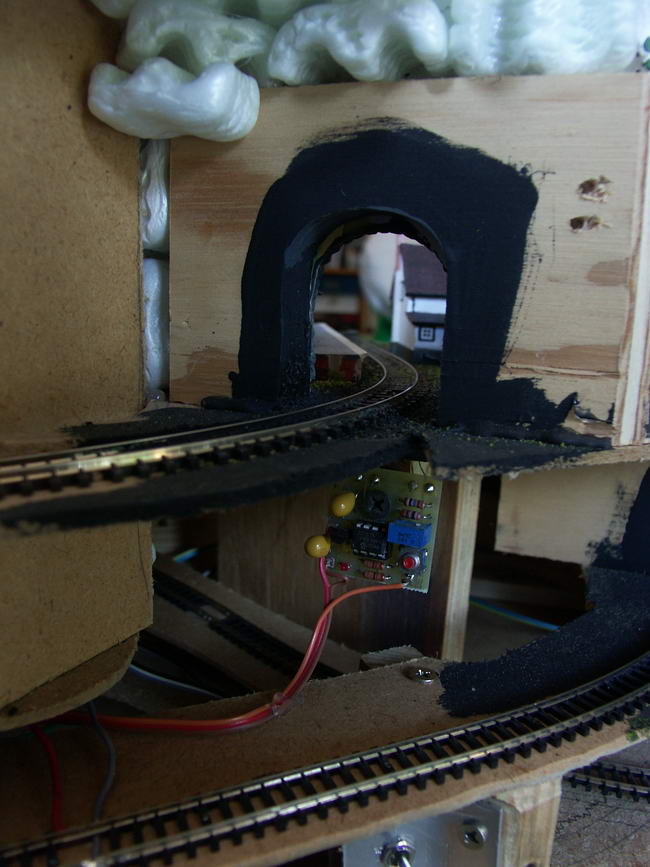
Here you can see a block detector, and the top station
viewed through the tunnel portal.
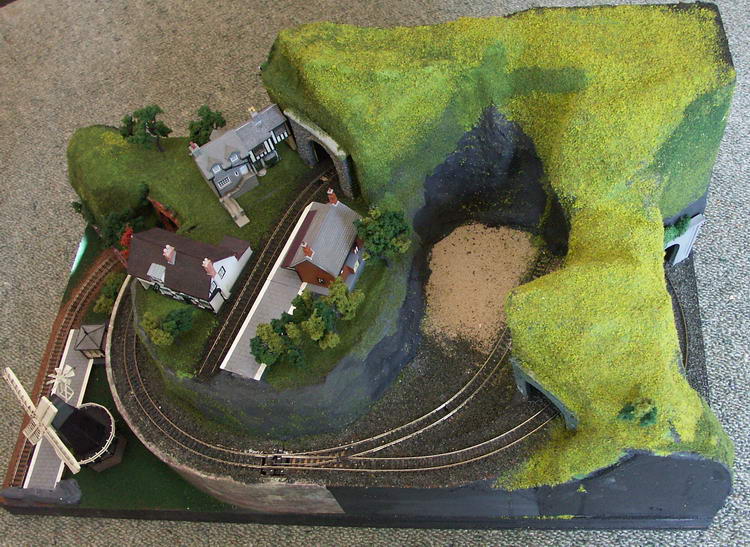
Here is the layout near completion.
The scenario is that the locals have a quarry that yields,
or once yielded, beautiful granites that were carried down to the
sea front for loading on boats. A rail line ran between
the docks and the quarry, and also extended up to the fertile
plains above where the townsfolk live. There is a small village,
pub and station perched atop the cliffs, where the townsfolk
come to take the train down to the docks.
You can just glimpse the small "beach" line at the right-hand
end of the layout.
Some close-ups
The decoration includes an N-scale "moutons et berger" set
from Preiser. The berger even comes with his dog. Seems
very appropriate for New Zealand, no?
Here is an 0-4-0 steam loco, maintained by the
local historical society, and two goods carriages
at the docks station, with the sea wall in the background,
and the Boar's Head pub visible up on the top of the cliff.
The model buildings are all from the Hornby "Lyddle End" range.
The tunnel portals are cast and painted by me and my daughter
Merinda; the figures are Preiser, again mostly painted by us.
This picture gives a good idea of the multiple levels of the layout.
It is a three-level layout, with the beach loop on a "mezzanine" level.
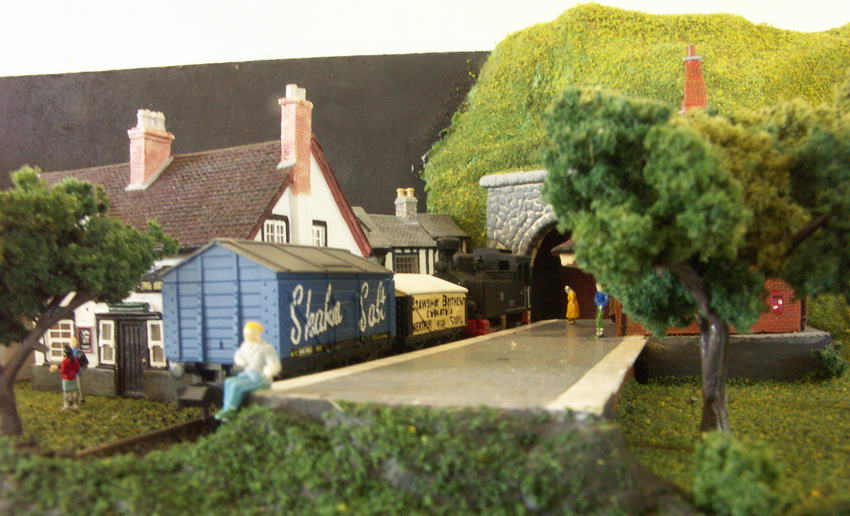
Here is the same steam train at the village station.
Edwin and I made the trees from Woodland Scenics supplies.
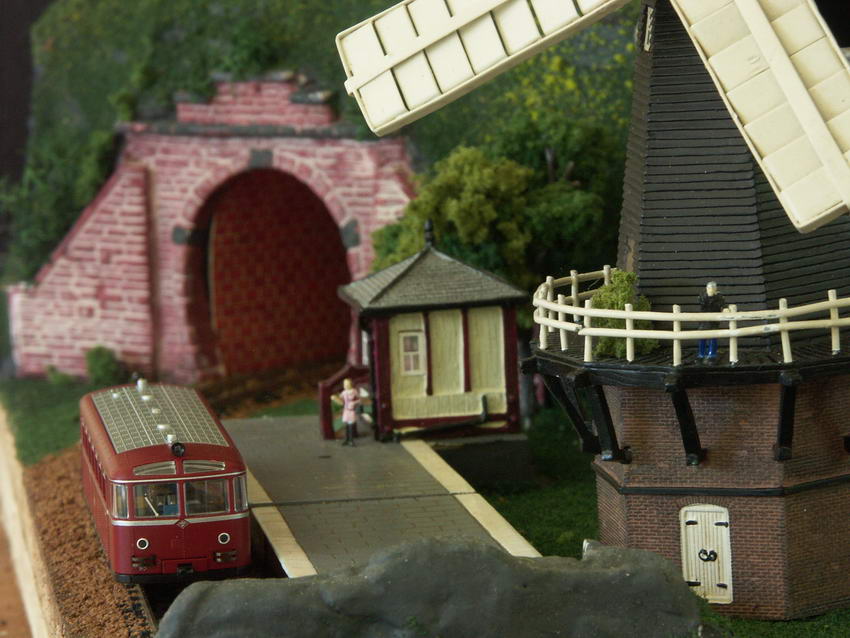
Here you see an old German railcar that has been restored by the
local Model Engineers Society. It is waiting at the docks station
for passengers off the ferry to the mainland.
Note the one-armed windmill keeper looking out to sea from
the catwalk of the windmill.
The scenario is that the docks area tends to be drenched if
the waves are up, and the sea wall protects the cliffs from erosion,
while the windmill can pump the station area if need be.
This image shows the steam train atop the sea wall, half way up to the
village station. Note the sea wall and its mossy-green base.
Up in the village you can see some of the cottages behind the
pub and station. There is a small stream formed by water coming out of the tunnel
and cascading down past the sea-wall tunnel portal.
This view gives a good idea of the multilevel nature of the run up the
cliffs.
 This is the finished layout pictured from above.
The distinguishing technical features of the layout are that it has
a 6-inch turn radius in N-scale track allowing a substantial trip
length on three levels in a small space,
and it is an end-to-end design that uses a
P684SV train controller
to automate train operation between stations.
This is the finished layout pictured from above.
The distinguishing technical features of the layout are that it has
a 6-inch turn radius in N-scale track allowing a substantial trip
length on three levels in a small space,
and it is an end-to-end design that uses a
P684SV train controller
to automate train operation between stations.

 Like the "Journey" layout, this one saw work on two continents and took
some time from start to finish... but only about a year, compared to a
decade for the Journey. Here you see the chassis, constructed in
February 2006, while we were still in California.
Like the "Journey" layout, this one saw work on two continents and took
some time from start to finish... but only about a year, compared to a
decade for the Journey. Here you see the chassis, constructed in
February 2006, while we were still in California.
 This is the chassis from below, with the bottom
cover board removed, to show some of the
This is the chassis from below, with the bottom
cover board removed, to show some of the
 The terrain was fashioned by using foam packing "nuts"
the shape of knuckle-bones as bricks, with hot glue
as mortar. This was subsequently covered with plaster
cloth.
The terrain was fashioned by using foam packing "nuts"
the shape of knuckle-bones as bricks, with hot glue
as mortar. This was subsequently covered with plaster
cloth.
 Here is the layout after the terrain was covered and
crudely painted, platforms added and some grass and
gravel added.
Here is the layout after the terrain was covered and
crudely painted, platforms added and some grass and
gravel added.
 Here you can see a block detector, and the top station
viewed through the tunnel portal.
Here you can see a block detector, and the top station
viewed through the tunnel portal.
 Here is the layout near completion.
The scenario is that the locals have a quarry that yields,
or once yielded, beautiful granites that were carried down to the
sea front for loading on boats. A rail line ran between
the docks and the quarry, and also extended up to the fertile
plains above where the townsfolk live. There is a small village,
pub and station perched atop the cliffs, where the townsfolk
come to take the train down to the docks.
You can just glimpse the small "beach" line at the right-hand
end of the layout.
Here is the layout near completion.
The scenario is that the locals have a quarry that yields,
or once yielded, beautiful granites that were carried down to the
sea front for loading on boats. A rail line ran between
the docks and the quarry, and also extended up to the fertile
plains above where the townsfolk live. There is a small village,
pub and station perched atop the cliffs, where the townsfolk
come to take the train down to the docks.
You can just glimpse the small "beach" line at the right-hand
end of the layout.
 The decoration includes an N-scale "moutons et berger" set
from Preiser. The berger even comes with his dog. Seems
very appropriate for New Zealand, no?
The decoration includes an N-scale "moutons et berger" set
from Preiser. The berger even comes with his dog. Seems
very appropriate for New Zealand, no?
 Here is an 0-4-0 steam loco, maintained by the
local historical society, and two goods carriages
at the docks station, with the sea wall in the background,
and the Boar's Head pub visible up on the top of the cliff.
Here is an 0-4-0 steam loco, maintained by the
local historical society, and two goods carriages
at the docks station, with the sea wall in the background,
and the Boar's Head pub visible up on the top of the cliff.
 Here is the same steam train at the village station.
 Here you see an old German railcar that has been restored by the
local Model Engineers Society. It is waiting at the docks station
for passengers off the ferry to the mainland.
Note the one-armed windmill keeper looking out to sea from
the catwalk of the windmill.
Here you see an old German railcar that has been restored by the
local Model Engineers Society. It is waiting at the docks station
for passengers off the ferry to the mainland.
Note the one-armed windmill keeper looking out to sea from
the catwalk of the windmill.
 This image shows the steam train atop the sea wall, half way up to the
village station. Note the sea wall and its mossy-green base.
Up in the village you can see some of the cottages behind the
pub and station. There is a small stream formed by water coming out of the tunnel
and cascading down past the sea-wall tunnel portal.
This image shows the steam train atop the sea wall, half way up to the
village station. Note the sea wall and its mossy-green base.
Up in the village you can see some of the cottages behind the
pub and station. There is a small stream formed by water coming out of the tunnel
and cascading down past the sea-wall tunnel portal.